Table of Contents

Larissa Schwartz · Dissertation

From Pilot to Global Scale: Iterative Teaching and Curriculum Design for Introduction to Generative Artificial Intelligence
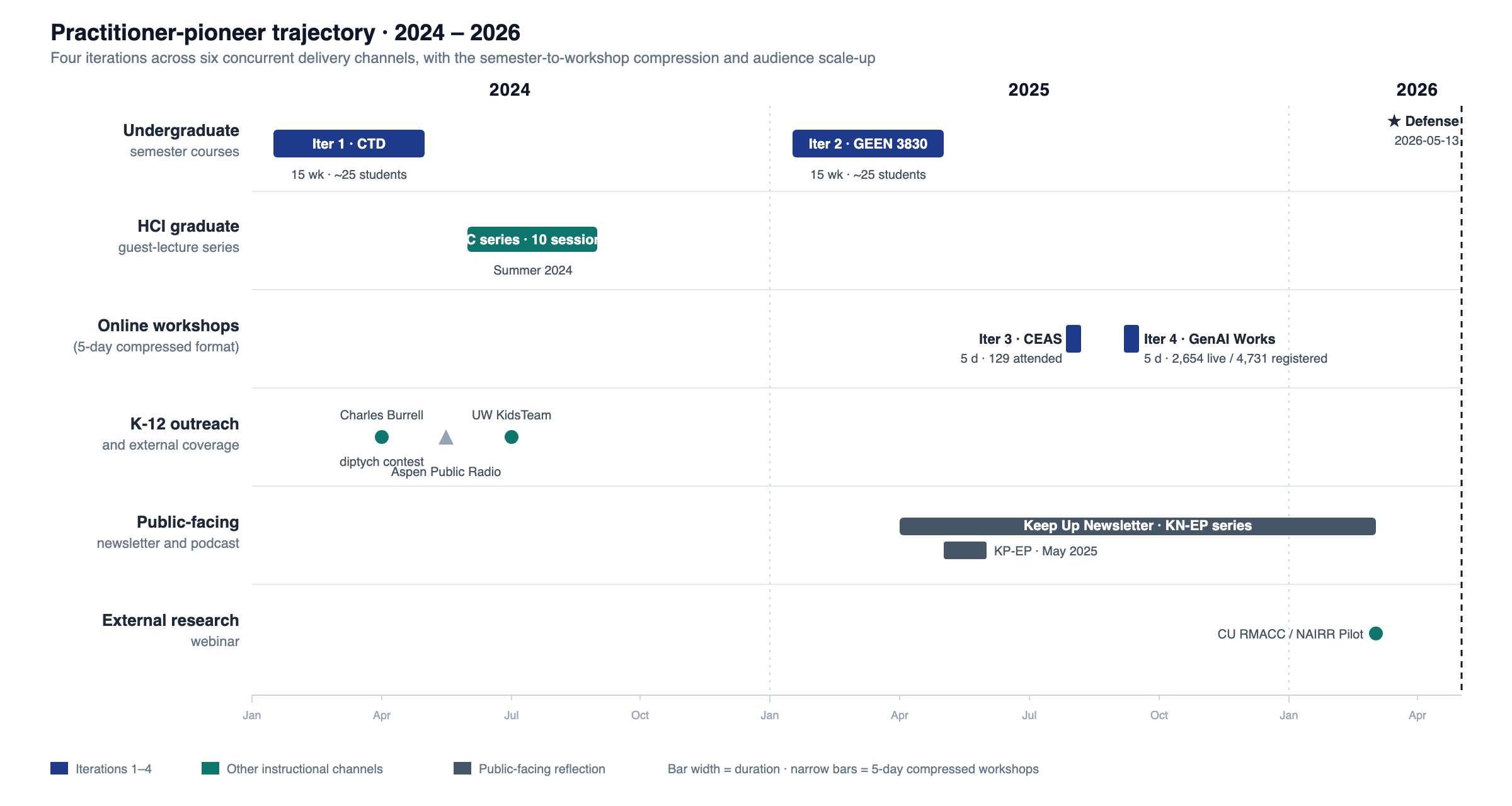
Practitioner-pioneer trajectory across six concurrent delivery channels, January 2024 through May 2026
Practitioner-pioneer trajectory across six concurrent delivery channels, January 2024 through May 2026. Iterations 1 and 2 are 15-week semester courses; Iterations 3 and 4 are 5-day compressed workshops. The HCI graduate guest-lecture series, K-12 outreach, the Keep Up Newsletter and Podcast, and the CU RMACC federal-research webinar appear in their own swimlanes. The figure recurs in main §3.1 and appendix §C.1.

Main Dissertation

  1. 1 Introduction

    1. §1.1 Background and Rationale
    2. §1.2 Literature Review
    3. §1.3 Problem Statement
    4. §1.4 Purpose of the Study
    5. §1.5 Significance of the Study
    6. §1.6 Research Questions
    7. §1.7 Theoretical Framework
  2. 2 Methodology

    1. §2.1 Research Approach and Framework
    2. §2.2 Curriculum-as-Research
    3. §2.3 Curriculum-as-Research Framework
    4. §2.4 Design-Based Research
    5. §2.5 Iterative Teaching as Inquiry
    6. §2.6 Curriculum Artifacts and Course Evaluation Inputs
    7. §2.7 Data Analysis Procedures
    8. §2.8 Ensuring Trustworthiness
  3. 3 Results

    1. §3.1 Overview of Course Iterations and Data Sources
    2. §3.2 RQ1 · Principles and Practices
    3. §3.3 RQ2A · Adapting to Different Learning Environments
    4. §3.4 RQ2B · Responding to the GenAI Technology Landscape
  4. 4 Discussion

    1. §4.1 Cross‑cutting patterns
    2. §4.2 Unexpected Findings
  5. 5 Conclusion

    1. §5.1 Contributions to theory and research
    2. §5.2 Implications for practice
    3. §5.3 Limitations and directions for future research
    4. §5.4 Closing synthesis

Appendix

  1. A Positionality and Curriculum

    1. §A.1 Literature survey
    2. §A.2 Practitioner-pioneer biography
    3. §A.3 Institutional positioning
    4. §A.4 The four-theme curriculum architecture
    5. §A.5 Theme stability across contexts
  2. B Autoethnographic Supplement

    1. §B.1 Literature survey
    2. §B.2 How analytic autoethnography supplements design-based research
    3. §B.3 Anderson's five criteria, each evidenced
    4. §B.4 Data sources
    5. §B.5 Analytic process
    6. §B.6 Trustworthiness
    7. §B.7 Reflexivity performed
  3. C Iteration Narratives

    1. §C.1 Framing the iterations through analytic autoethnography
    2. §C.2 Iteration 1 · CTD Pilot · Spring 2024
    3. §C.3 Iteration 2 · Mixed Engineering · Spring 2025
    4. §C.4 Iteration 3 · GenAI in Five Cohort 1 · August 2025
    5. §C.5 Iteration 4 · GenAI Works Cohort · September 2025
    6. §C.6 Cross-iteration comparative analysis
  4. D Autoethnographic Findings

    1. §D.1 Framing through autoethnographic elaboration of the three principles
    2. §D.2 Modularity · the architecture's stability seen from inside
    3. §D.3 Learner Choice · dialogue with informants across channels
    4. §D.4 Continuous Feedback · the reflexive loop in practice
    5. §D.5 Contributions
    6. §D.6 Artifact inventory
  5. E Evidence Table

    1. §E.1 Evidence Table
  6. F AI Use Disclosure

    1. §F.1 AI Use Disclosure
  7. G References

    1. §G.1 References