Cross-iteration comparative analysis
In this section I step back from the iteration-by-iteration narratives (§C.2 through §C.5) and surface the patterns that the four iterations together exhibit. The patterns are five: tool turnover, module-placement evolution, guest-speaker turnover, student-to-instructor tool flow, and stable elements that persist across the iterations.
C.6.1 Tool turnover across iterations
The tool list shifted substantially between iterations, driven by the rapid public release of new generative-AI tools across 2024 and 2025. Comparing the Canvas LMS exports (CV-1 and CV-2) and the workshop decks (DK-3 and DK-4) surfaces specific tools added, repositioned, and dropped.
Tools added in Iteration 2 (Spring 2025) that were not present in Iteration 1 (Spring 2024):
- DeepSeek · added Week 3 within weeks of its January 2025 public release
- Claude 3.7 · added to Week 8 readings
- Grok 3 · added to Week 8 readings
- AI Agents · introduced as a full new module across Weeks 7 to 9, with the explicit assignment "Create your own AI Agent"
- NotebookLM · moved from student-mentioned in Iteration 1 to dedicated guest lecture (Bobby Hodgkinson, February 10, 2025) in Iteration 2
- Be My AI · added to the Accessibility-theme block as a lived-experience-relevant accessibility tool
- Sora · added to the video-generation block as the OpenAI video model
- HeyGen · added to the video-generation block as the avatar-and-presentation tool
- ElevenLabs · added to the audio-generation block as the voice-cloning and text-to-speech tool
- Custom GPTs with Wolfram API · introduced as a workflow that combined Custom GPTs with the Wolfram computational backend
Tools repositioned between iterations:
- Hugging Face · moved from Iteration 1 Week 9 (Daniel Ritchie's live workshop) to Iteration 2 Week 7 (with Ritchie's video assigned for the iteration rather than a live appearance)
Tools dropped between iterations:
- Reality Editor · present in Iteration 1 Week 10 with Suibi Weng as live guest; absent from Iteration 2
Tools that recurred across all four iterations:
- ChatGPT (and successors in the OpenAI line)
- Midjourney (used in the Self-Portrait Assignment across all four iterations)
- DALL-E (used at the STEAM Festival mural and across the iterations)
- Soundful (introduced via Iteration 1 student Ethan Cuenca, retained through Iteration 4)
- Prompt engineering (as a meta-tool, anchoring Week 1 of every iteration)
The pattern is substantial tool turnover (more than ten new tools introduced in Iteration 2 alone) absorbed by a stable four-theme architecture. The architecture is the part that does not change; the tool list is the part that does.
C.6.2 Module-placement evolution
Beyond tool turnover, module placement within the semester structure shifted between Iterations 1 and 2:
| Module | Iteration 1 placement | Iteration 2 placement | Shift |
|---|---|---|---|
| Prompt engineering opener | Week 1 | Week 1 | Stable |
| Midjourney Self-Portrait | Week 2 | Week 1 (DK-2.JAN15) | Earlier |
| Education theme block | Weeks 2-4 | Weeks 1-4 | Stable to slightly earlier |
| Industry theme block opening | Week 5 | Week 8 | Delayed 3 weeks |
| Hugging Face | Week 9 (Ritchie live) | Week 7 (Ritchie video) | 2 weeks earlier; live to recorded |
| Video module | Week 6 | Week 14 | 8 weeks later |
| Ethics dedicated block | Weeks 10-12 (Klassen, Weng) | Cross-cutting only | Restructured to cross-cutting |
| Reality Editor | Week 10 (Weng) | Absent | Dropped |
| AI Agents module | Absent | Weeks 7-9 | Added |
| Accessibility theme block | Weeks 13-15 | Weeks 12-15 | Slightly earlier |
| Final Project | Weeks 13-15 | Final weeks | Stable |
The video module's eight-week shift (Iteration 1 Week 6 to Iteration 2 Week 14) is the largest single structural move. Several factors plausibly informed the move (the maturity of Sora and HeyGen as classroom-usable tools in 2025 that had not been classroom-usable in 2024; the placement of video as the closing technical theme before the Final Project), and my retrospective reflective memo for Iteration 2 develops the reasoning.
The compression-and-stabilization pattern documented in §D.3 emerges from the table. Most modules are stable in placement; a small number shift substantially; and the shifts cluster around modules whose tool support changed materially between iterations.
C.6.3 Guest-speaker network curation as an instructional move
Across the two semester iterations I assembled and revised a network of guest practitioners that together carried the curriculum's industry, ethics, and accessibility connections into the classroom. The curation pattern is itself a finding about how this pioneering practice operates. The roster is not a fixed lecture series; it is an actively curated rotating network, and the curation work is part of what the instruction consists of.
| Iteration 1 guests | Iteration 2 guests |
|---|---|
| Anthony Pinter (ATLAS, creativity) | (External, not returning live) |
| Diane Sieber (Herbst, writing) | (External, not returning live) |
| Matt Zago (finance-industry video) | (External, not returning live) |
| Daniel Ritchie (Hugging Face workshop) | Daniel Ritchie's video assigned to Week 7 (not live) |
| Nikolaus Klassen (Google ethics) | (External, not returning live) |
| Suibi Weng (Reality Editor) | (External, not returning) |
| Nolan Brady plus Shivendra (Education) | Nolan Brady on GenAI in NeuroImaging (returning CU guest with different topic) |
| --- | Tom Yeh on DeepSeek (new CU-internal guest) |
| --- | Bobby Hodgkinson on NotebookLM (new CU-internal guest) |
| --- | Justin Shacklette on GenAI for Software (new industry guest) |
Three properties of the curation are worth naming.
1. Industry relevance was sustained across iterations through deliberate rotation. Iteration 1 carried Matt Zago on finance-industry generative-AI applications and Nikolaus Klassen on industry-internal ethics from Google; Iteration 2 carried Justin Shacklette on software engineering and Bobby Hodgkinson on notebook environments. The specific industries shifted (finance, ethics, software engineering, data tooling) but the industry-presence commitment was preserved. Students at every iteration encountered generative AI as a practice with industry stakes and named industry practitioners, not as a research curiosity.
2. CU-internal continuity sustained the network across topic turnover. Nolan Brady's recurrence from Iteration 1 to Iteration 2 with a different lecture topic shows that the network's continuity is by-relationship, not by-fixed-content. Tom Yeh's appearance in Iteration 2 (DeepSeek) and again in Iteration 4 (Day 1 of the GenAI Works workshop, from CU Boulder) extends the same pattern across the iterations. The network's CU-internal core can be re-aimed at new topics as the technology landscape moves.
3. External speakers cycle out at high rates as topics evolve. Iteration 1's external speakers (Pinter, Sieber, Zago, Klassen, Weng) did not return live in Iteration 2. This is not a failure of relationship maintenance; it is a feature of the curation. When the technology landscape shifts (DeepSeek and AI Agents emerge between Spring 2024 and Spring 2025), the appropriate external voices shift with it. A fixed external roster would have meant covering 2024 topics in a 2025 course.
The curation work is therefore part of the pedagogical contribution, not infrastructure separate from it. Documenting who I brought in, when, and why is documenting how a pioneer instructor sustains industry connection and topical currency across iterations. The administrative spreadsheets (AS-2.GUESTS, AS-2.TEACHOUT-DATES, AS-2.TEACHOUT-INDEX, AS-2.FINAL-SCHED) are the operational trace of this curation work in Iteration 2; Iteration 1's curation lives in the Canvas export (CV-1) and the Weekly Updates Prelim Document.
C.6.4 Student-to-instructor tool flow · the Ethan Cuenca to Soundful case
One of the most analytically interesting cross-iteration patterns is the documented flow of a tool from a student in Iteration 1 into the instructor's curriculum for Iterations 2, 3, and 4. The flow is documented through three independent artifacts:
-
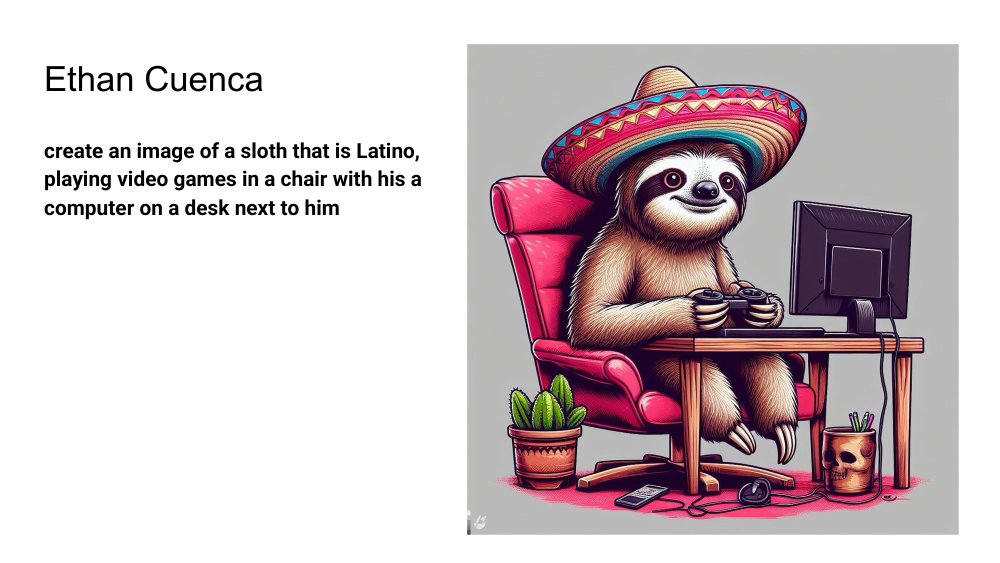
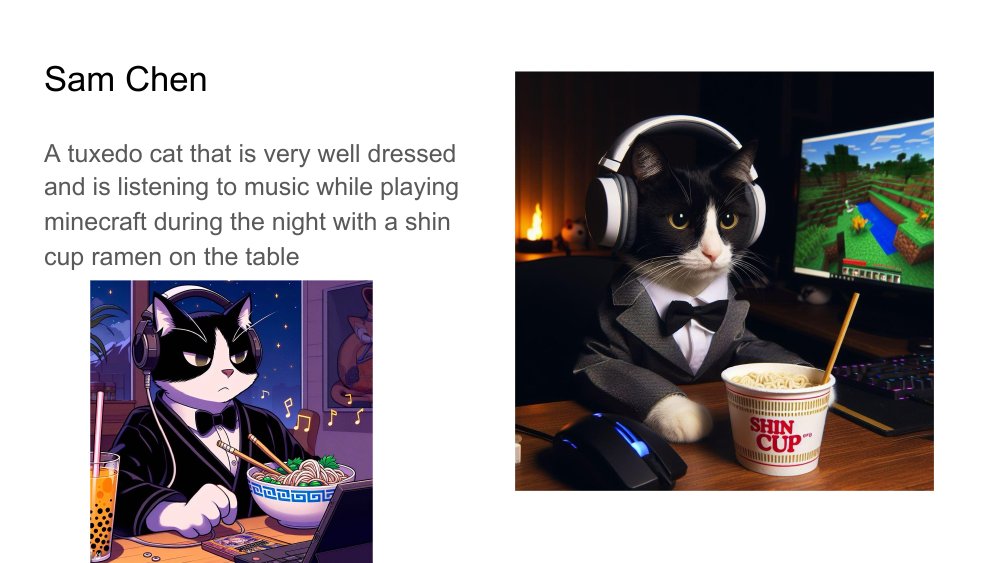
Slide 13 of the Iteration 1 Week 1 deck (DK-1.W01) names Ethan Cuenca as one of the twenty-three students whose prompt-engineering outputs are displayed in the opening session.
-
The Weekly Updates Prelim Document (WU-1 series) notes that one student presented on the GenAI music tool Soundful, and that I incorporated the student's discovery into the class assignment.
-
Keep Up Newsletter Episode 3 (KN-EP3-Q1) publicly credits the flow:
"I learned about Soundful from one of my students during class."
Following Iteration 1, Soundful appeared in the Iteration 2 curriculum (visible in CV-2), in the Iteration 3 workshop deck (DK-3), and in the Iteration 4 workshop delivery (TR-4.D3 carries Soundful as part of the Audio-generation day). The tool persisted across all four iterations following its student-discovery introduction.
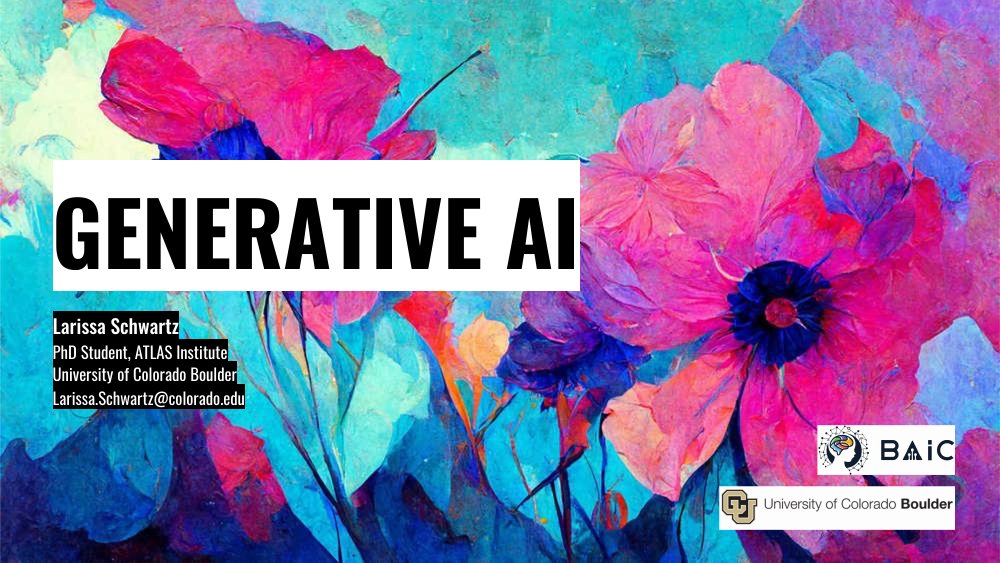
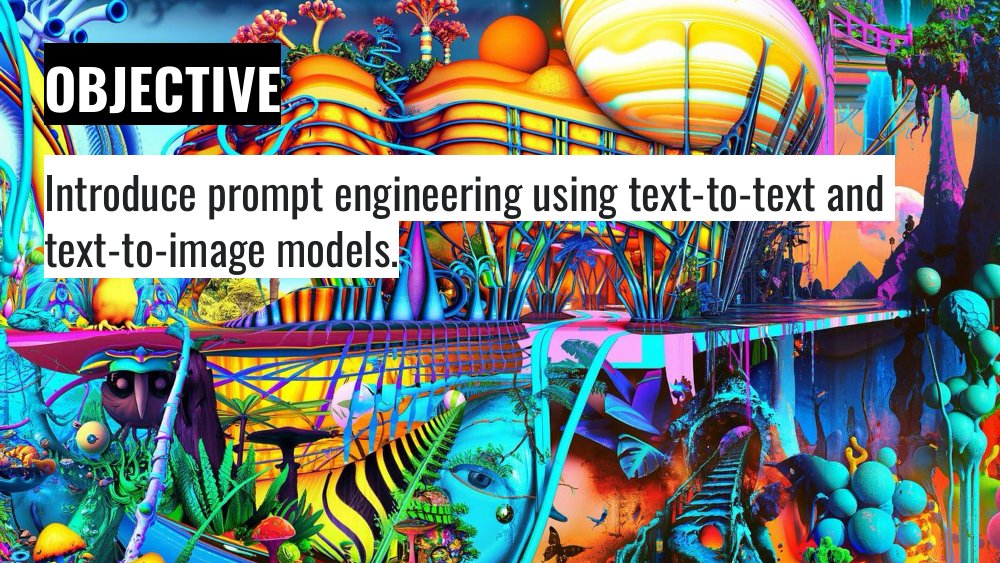
This is the autoethnographic claim "student co-discovery shaped the curriculum" made concrete at the level of a single named instance: a named student, an Iteration 1 dated artifact, a contemporaneous reflective note, a public-facing acknowledgment, and persistent presence in the subsequent curriculum. I want to be precise about what this is and is not: it is one well-documented case, not a pattern with multiple documented instances. Other student tool discoveries shaped the curriculum across the iterations (the Iteration 1 Final Project, the Iteration 2 teach-out presentations, the Iteration 3 Luma feedback all surfaced tool suggestions), but they are not documented with the same precision as the Cuenca-to-Soundful flow. The single named case speaks to the dialogue-with-informants-beyond-self criterion (§B.3.4) at the cross-iteration scale; it is offered as a concrete instance of a broader phenomenon I observed but did not document case-by-case. \autoref{fig:dk1-w01-gallery} samples DK-1.W01 to show the named-student-output slides on which the Cuenca case rests.

C.6.5 Stable elements across all four iterations
What does not change across the four iterations is as analytically important as what does. Five elements are stable from Iteration 1 through Iteration 4:
The four-theme architecture. Education, Industry, Ethics, Accessibility, with Ethics increasingly positioned as cross-cutting across the others. The architecture is named explicitly in DK-1.FG (slides 5-9) for Iteration 1, in SY-2 for Iteration 2, in DK-3 for Iteration 3, and in DK-4 for Iteration 4.
The Week 1 prompt-engineering opener. Iteration 1 (DK-1.W01), Iteration 2 (DK-2.JAN13), Iteration 3 (DK-3 Day 1), and Iteration 4 (DK-4 Day 1, TR-4.D1) all open with prompt engineering. The opener is the most stable single curricular element in the corpus.
The Midjourney Self-Portrait Assignment. Used in Iteration 1 (Week 2), Iteration 2 (Week 1, DK-2.JAN15), and the workshops (Day 1 of Iterations 3 and 4 within the image-generation block). The assignment is the most stable single hands-on element.
Hallucination as teachable topic. Appears in Iteration 1 Week 1 reflection (WU-1.W01-Q1), in cross-iteration public writing (KN-EP1-Q1), and in the most recent workshop delivery (TR-4.D1). The hallucination-as-pedagogy finding (§D.2) is anchored at this stable element.
Named student outputs as opening-session content. The dialogue-with-informants criterion is performed at the opening of every iteration through named student work. Iteration 1's twenty-three named outputs in DK-1.W01 set the pattern; subsequent iterations continued the practice of naming student contributions in opening-session content.
The stable elements together constitute the durable pedagogical contribution of the four iterations. The architecture survived, the Week 1 opener survived, the Self-Portrait Assignment survived, the hallucination treatment survived, and the practice of naming student contributions survived. These are the elements that the cross-iteration distillation kept.
C.6.6 Compression in the timeline
The final cross-iteration pattern is the compression of delivery time:
| Iteration | Duration | Formal class time |
|---|---|---|
| 1 · CTD Pilot | 15 weeks | ~45 hours |
| 2 · Mixed Engineering (GEEN 3830) | 15 weeks | ~45 hours |
| 3 · GenAI in Five Cohort 1 | 5 days | ~5 hours |
| 4 · GenAI Works Cohort | 5 days | ~5 hours |
The compression ratio from semester to workshop is approximately nine-to-one in formal class time. The compression preserved the four-theme architecture, the Week 1 prompt-engineering opener, the Midjourney Self-Portrait Assignment, the hallucination-as-pedagogy treatment, and the practice of dialogue with informants beyond self. The compression-as-curriculum-maturation finding (§D.3) is the analytic claim that this compression represents.
C.6.7 Synthesis
The four iterations exhibit a coherent practitioner-pioneer trajectory. Iteration 1 was the discovery phase. Iteration 2 was the consolidation phase. Iterations 3 and 4 were the distillation phase. Across the trajectory, the four-theme architecture stabilized as the durable contribution, the tools turned over substantially, the guest network adapted, the student-to-instructor tool flow operated as a named case, and the delivery compressed approximately six-fold without content loss.
Chapter D develops the analytic claims that emerge from this trajectory: hallucination-as-pedagogy (§D.2), compression-as-curriculum-maturation (§D.3), and multi-channel teaching practice (§D.4).