Overview of Course Iterations and Data Sources
This chapter presents the findings from the iterative design, implementation, and refinement of the Introduction to Generative AI course across four different iterations. Aligned with the curriculum-as-research and design-based research frameworks described in Chapter 2, the results focus on how changes to the syllabus, instructional materials, and learner experiences addressed the research questions about adaptive GenAI curriculum design.
The chapter is organized around the research questions introduced in §1.6. First, I describe the principles and practices that emerged in the design and iterative teaching of the course (RQ1, §3.2). Next, I examine how the curriculum adapted to different learning environments, including two for-credit university offerings and two large-scale global courses (RQ2A, §3.3). Finally, I document how the course responded to the rapidly changing GenAI technology landscape, including tool updates, new platforms, and student discoveries of new technological applications (RQ2B, §3.4).
Across all four iterations, the analysis uses slide deck and module revisions, student surveys, student work, and written reflections described in Chapter 2. I examined these materials using thematic coding to find recurring patterns in course design and learner experiences.
Figure 1 visualizes the practitioner-pioneer trajectory across the four iterations and the six concurrent delivery channels that ran alongside them from January 2024 through May 2026.
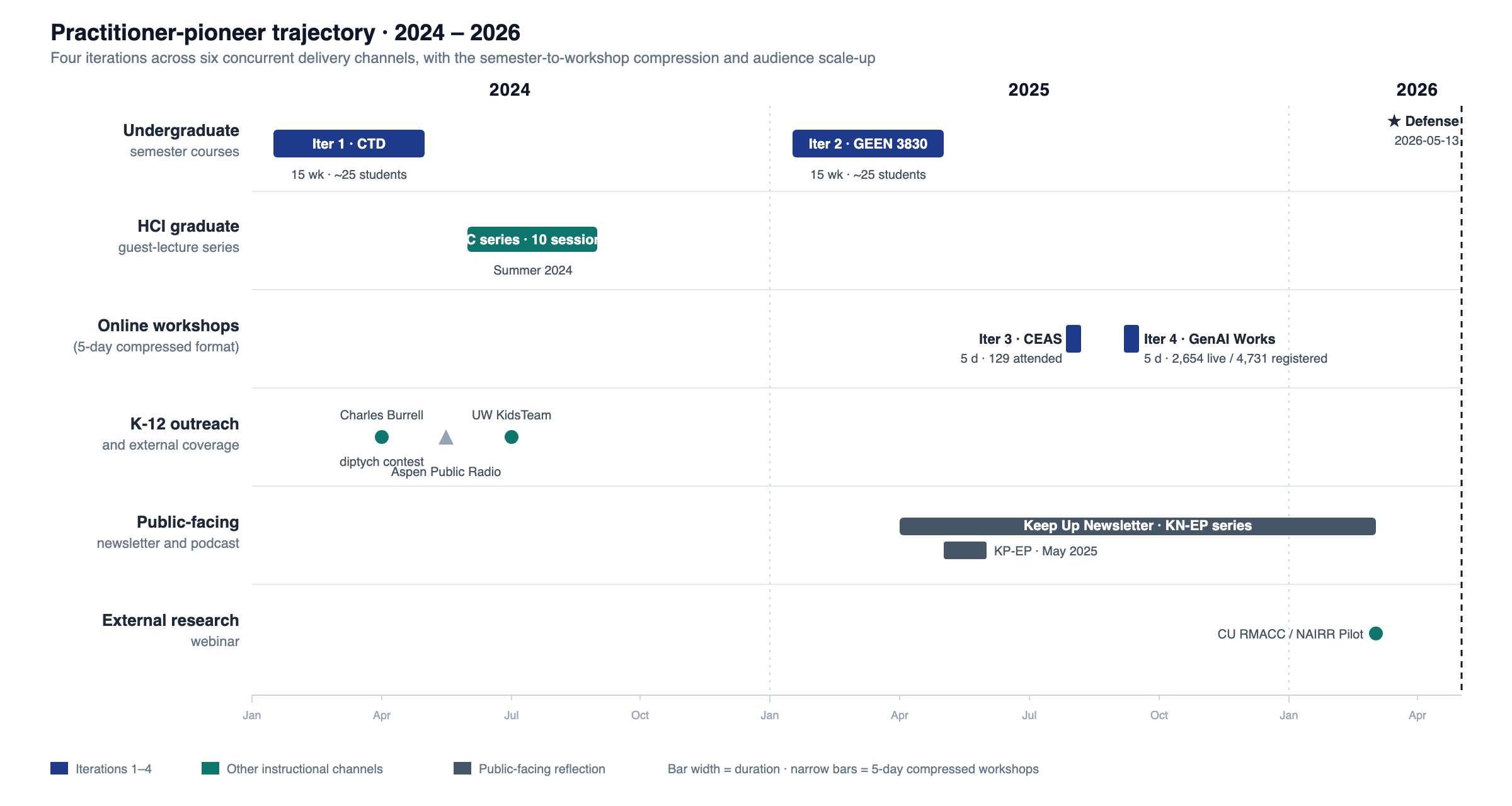
Table 2 summarizes the four course iterations that generated data for this study, including participant characteristics, institutional setting, delivery mode, and data sources. The first and second iterations were for-credit university courses with approximately 25 creative technology and design majors and approximately 25 mixed-discipline engineering students. The third and fourth iterations were free, non-credit global offerings: the third enrolled 411 participants with 129 attending live, and the fourth enrolled 4,731 participants with 2,654 attending live on Day 1.
Table 2. Overview of course iterations and data sources.
| Iteration | Setting | Delivery mode | GenAI topics | Data sources |
|---|---|---|---|---|
| CTD Pilot (~25 students) | For-credit, university | In-person | Image, video, sound | Modules, slide decks, surveys, written reflections, student work |
| Mixed Engineering Pilot (~25 students) | For-credit, university | In-person | Image, video, sound | Modules, slide decks, surveys, written reflections, student work |
| Global Course 1 (411 registered, 129 live) | Non-credit, badges, certificates | Virtual | Image, video, sound | Slide decks, surveys, student work |
| Global Course 2 (4,731 registered, 2,654 live Day 1) | Non-credit, certificates | Virtual | Image, video, sound | Slide decks, surveys, student work |
From these iterations, I collected revised slide decks and modules per lesson, student feedback surveys, student work artifacts, and written reflections, which created a detailed record of how the curriculum developed and how learners experienced image, video, and sound creation with GenAI tools. These data sources are the foundation for the qualitative analyses presented in the remainder of this chapter.