RQ2B · Responding to the GenAI Technology Landscape
I made sure the course stayed up to date with the fast pace of GenAI by keeping an eye on new developments, consistently updating lessons, and focusing on ideas and projects that could work with any GenAI tool.
3.4.1 Technology-Driven Module Revisions
First, I spent each week researching the latest GenAI models and tools. I read newsletters, followed social media, watched webinars and project updates, and tracked announcements from GenAI companies. This way, I knew when a new model or tool was released and could decide if it belonged in the next lesson for the curriculum.
Next, I split the syllabus into small units or modules so I only needed to change one lesson at a time. For example, if a GenAI model or tool changed or updated, I switched out the demonstration materials for that module without touching the rest of the coursework. This kept everything fresh without disrupting the overall flow of the class.
Then, I taught lessons that applied across different GenAI tools, like how to be successful at prompt engineering or check if a GenAI tool's output made sense, rather than focusing on a single platform. By showing students similar examples with different GenAI tools, they learned skills they could use no matter which GenAI application becomes popular next.
This continuous cycle of checking new tools, updating modules, and focusing on technological skills that work across platforms directly answers RQ2B by showing how the course stayed up to date with the fast-changing GenAI landscape.
3.4.2 Co-Discovery Through Teach-Out Slots and Course Evaluation Feedback
A scheduled teach-out slot at the start of each class invited students to present a recent GenAI tool they had encountered, and the post-module course evaluation prompts included an explicit field for new tools the curriculum should consider. I treated the teach-out content and that evaluation field as a recurring channel for surfacing new tools that needed to enter the curriculum. Each cycle I reviewed what had been surfaced, researched the most promising candidates, and revised the next iteration's slide deck to incorporate them. This pattern kept the course content current and is itself an instance of the modularity principle in §3.2.1: a single module can be refreshed with a new tool without rewriting the surrounding syllabus.
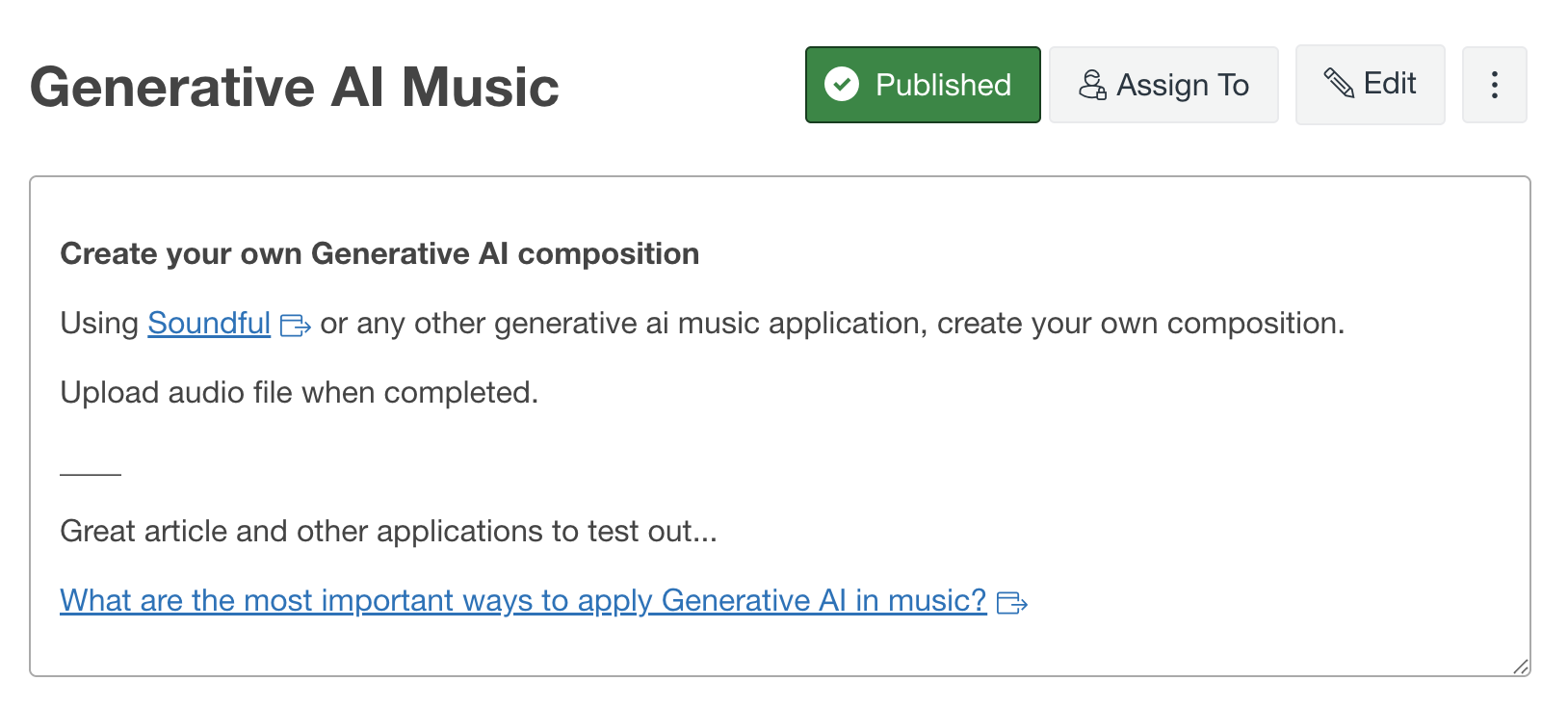
For example, a teach-out presentation in pilot 1 surfaced the GenAI music tool Soundful, which I subsequently added to the GenAI Music assignment in the next iteration's slide deck, shown in Figure 14.
Figure 14. GenAI Music assignment using Soundful, from Pilot 1.
The end-of-course evaluation comments from pilot 2 included reflections such as "From LLM resources such as NotebookLM to things like Lovable. The most useful things I learned this semester were from this class," and "The knowledge from this class is arguably the most valuable in today's age, as ChatGPT and other AI tools are such a common thing within the workspace. Knowing how to effectively and ethically employ these tools will be vital knowledge moving forward into industry, as they are able to accelerate workflows and make things a lot easier." Comments of this kind supported keeping the multi-tool, ethics-anchored framing in the next iteration of the curriculum.