The four-theme curriculum architecture
In this section I define the four-theme curriculum architecture that I built into my course from Iteration 1 onward. The architecture is the analytic spine of the dissertation. It is not a researcher's overlay on a course taught for other reasons; it is the framework I taught from the beginning.
A.4.1 The four themes
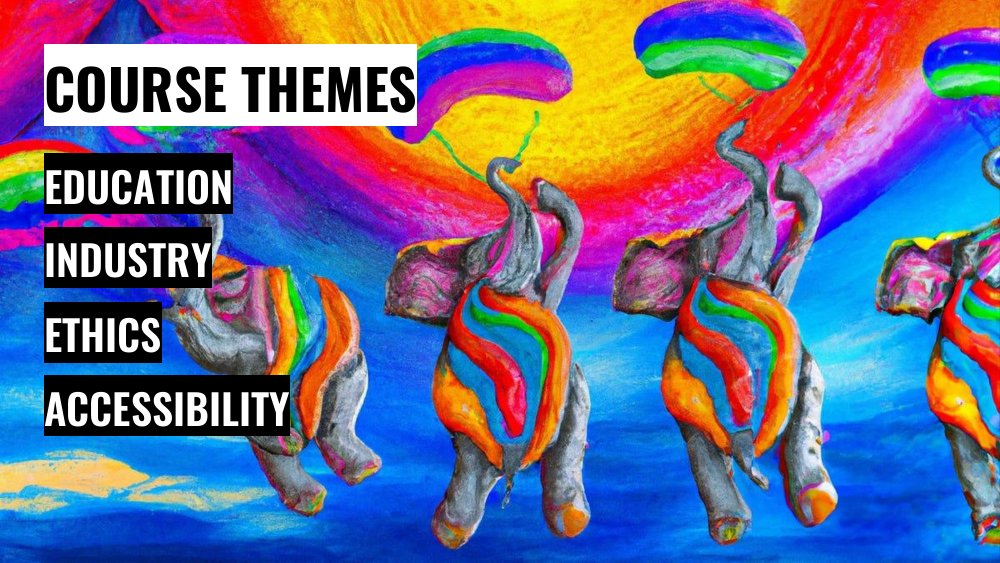
The four themes are Education, Industry, Ethics, and Accessibility. Each is defined below in terms of what generative AI does for a domain of practice, which is the framing I used in my own first-person essay (RE-Q4) and which appears across my Iteration 1 ForeverGold deck (DK-1.FG, slides 5-9), my Iteration 2 syllabus (SY-2), and my Iteration 1 Final Project Requirements (FP-1).
Education
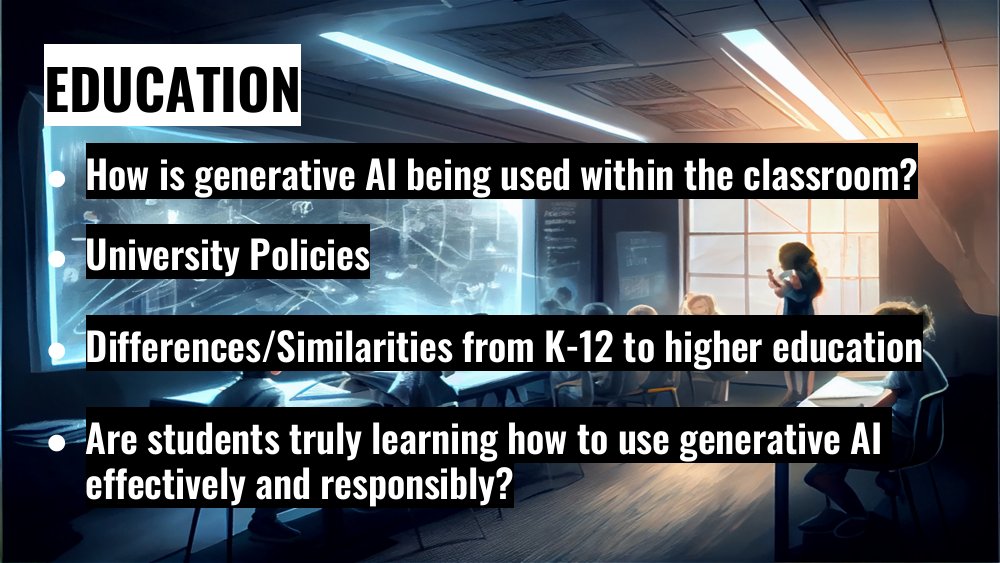
Education names the use of generative-AI tools within instructional settings: by teachers in lesson planning and material generation, by students in coursework and study, and by educational designers in curriculum design. The theme covers prompt engineering as a teachable skill, tool integration into existing curricula (drawing on my Charles Burrell professional-development experience, RE-Q2), and the question of how to teach with rather than against generative-AI tools. The Education theme is the opening territory in every iteration. Week 1 of Iterations 1 and 2 (DK-1.W01 and DK-2.JAN13) is the prompt-engineering opener; the early weeks of both semester iterations cover Education before moving outward into the other themes.
Concrete example. Iteration 1 Week 1 (January 17, 2024) opened with a prompt-engineering lecture and an interactive assignment in which students wrote five facts about themselves, used ChatGPT to generate multiple-choice quizzes from those facts, used DALL-E 3 via Microsoft Designer to generate an "alter-ego animal" image of themselves, and exchanged the quiz and image with a partner as an introduction activity (per the Week 1 entry in WU-1.W01). The activity instantiates the Education theme on three levels at once: it is a teacher's lesson plan using a generative-AI tool, it is a student-facing assignment in prompt engineering, and it is curriculum design with the tool as a structural element rather than as a peripheral exercise. Twenty-three named student outputs from the session are preserved in DK-1.W01.
Industry
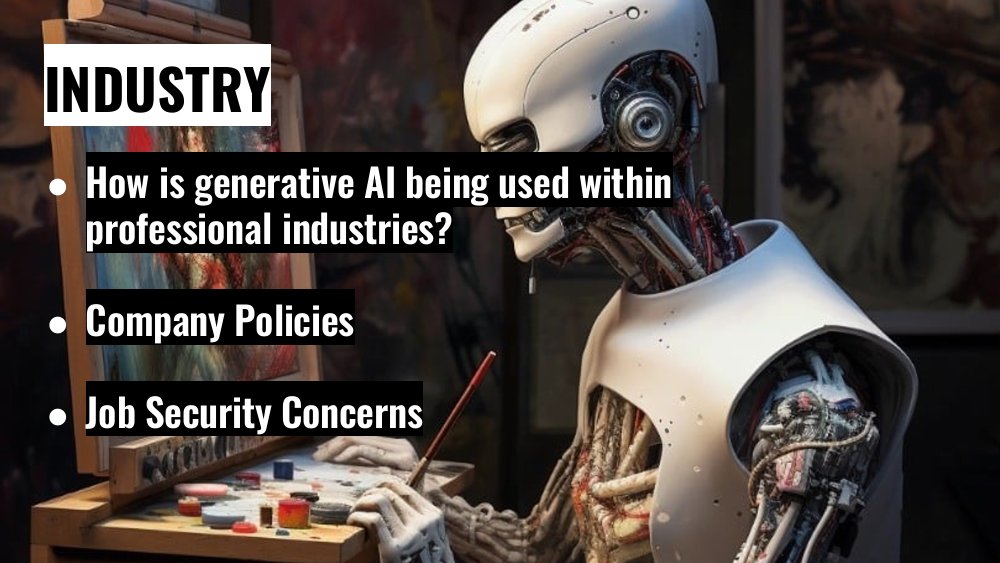
Industry names the use of generative-AI tools in professional work outside the classroom. The theme covers software engineering (DK-2 has Justin Shacklette as the GenAI-for-Software guest in Iteration 2), data tooling and notebook environments (Bobby Hodgkinson on NotebookLM in Iteration 2), and the practical workplace applications students would encounter as they entered industry. Iteration 1 brought industry voices through Daniel Ritchie's Hugging Face workshop and Matt Zago's video work; Iteration 2 brought industry voices through Tom Yeh on DeepSeek and Justin Shacklette on software engineering. The Industry theme operates as the practical-application bridge between Education and the more critical themes that follow.
Concrete example. Iteration 1 Week 5 was the opening week of the Industry theme block. I delivered a lecture on how generative AI is used across professional industries and then split the students into small groups, with each group assigned a specific industry application category to research and report back to the class. The categories named in WU-1.W05 include Augment Data, Synthetic Data, Drug Design, Design Neural Network, Chip Design, Create Algorithm, Design of Parts, 3D Shape Creation, Create Text, Increase Image Resolution, Creation of an Instance Image, Image-to-Image Conversion, Text-to-Speech Generator, Create Music, Generate Videos, Generate Image, and Material Science. The activity converts the Industry theme from a topical block into a student-driven survey of generative-AI applications across professional domains, with each student becoming the class's local expert on one application category.
The curated industry network as part of the contribution. Beyond the activity structure, my Industry-theme contribution includes the network of practitioners I curated to bring into the classroom across the two semester iterations. Daniel Ritchie (Hugging Face workshop, Iteration 1) brought open-model practice into reach of undergraduates; Matt Zago (Iteration 1) brought finance-industry generative-AI applications; Nikolaus Klassen (Google, Iteration 1) brought industry-internal ethics; Justin Shacklette (Iteration 2) brought GenAI for software engineering; Bobby Hodgkinson (Iteration 2) brought NotebookLM and the data-tooling perspective. The roster was not a fixed lecture series. It was an actively rotating network I assembled, replenished, and re-aimed at each iteration's evolving technology landscape. The curation work itself is part of what the Industry-theme contribution consists of: students did not encounter generative AI as an abstract category but as an industry-applied practice represented by named practitioners I had identified, invited, and embedded into the course. The cross-iteration guest-speaker turnover documented in §C.6.3 makes the curation visible as an instructional practice in its own right.
Ethics
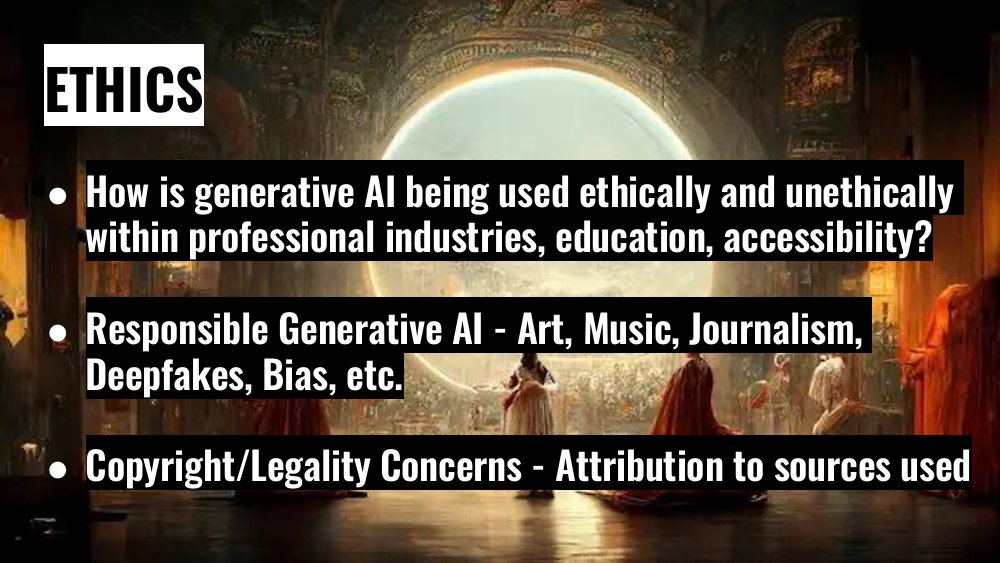
Ethics names the cross-cutting attention to questions of consent, harm, fairness, intellectual property, environmental cost, and human creativity that generative-AI tools raise. In my Research Impact Essay I named Ethics as "the ethical concerns that arise while using these programs" (RE-Q4), framing it as a cross-cutting theme that runs through Education, Industry, and Accessibility rather than as a standalone theme of equal kind. The Iteration 2 syllabus (SY-2) is consistent with this framing: it schedules Education, Industry, and Accessibility as discrete blocks while marking Ethics as a thread that runs through all of them. The Iteration 1 Final Project Requirements (FP-1) operationalize this with a dedicated ethics question, "Do you think this will eliminate creative jobs?", that runs alongside the technical and applied questions in the same assignment. I treat Ethics as the architecture's cross-cutting fourth theme in this dissertation, while acknowledging that the curriculum-as-taught sometimes treats it as a standalone block (Iteration 1 Weeks 10-12 with Klassen Google ethics and Weng Reality Editor are the visible exception).
Concrete example. Iteration 1 Week 7 surfaced Ethics within the Industry theme through a deepfakes-and-music sequence. I delivered a lecture on the ethics of generative-AI video and audio (deepfake videos, face swaps, audio deepfakes), discussed the "Heart on My Sleeve" case study in which Drake's and the Weeknd's voices were generatively reproduced without consent, and assigned the students to find a song that had been AI-generated and identify the signals by which they had known it was generated (per WU-1.W07). Students then created their own deepfake videos and still images using ROOP or a generative-AI app of their choice, framed explicitly as ethical deepfakes for educational use, and reflected on the experience in writing. The activity makes Ethics concrete by asking students to enact the technology, surface their own reasoning about its limits, and produce a reflection. The cross-cutting framing means the Ethics work appears inside the Industry theme rather than in a separate Ethics block.
Accessibility
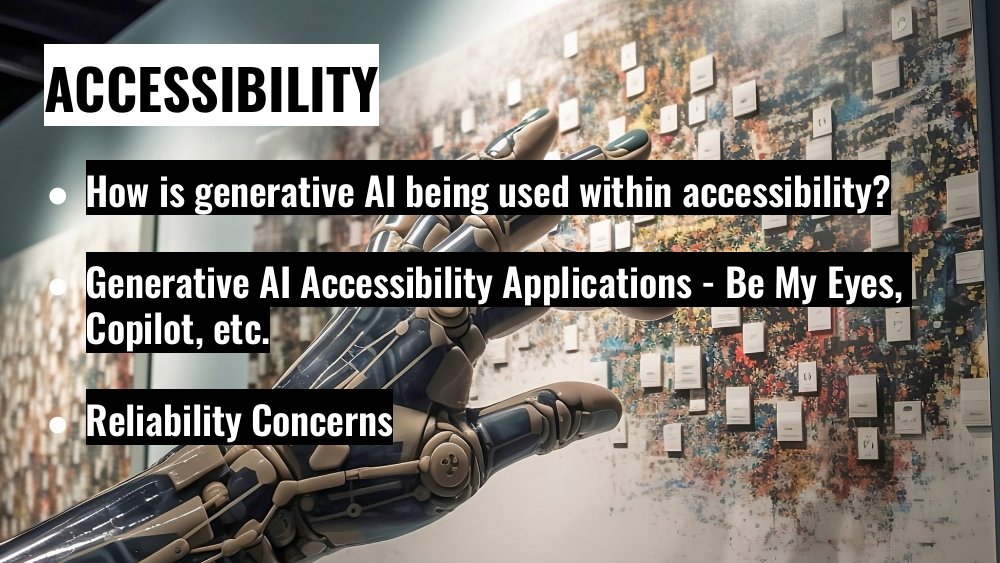
Accessibility names the use of generative-AI tools in the lives of people with disabilities and in service of equitable access. The theme covers tools designed for accessibility (Be My AI for blind and visually-impaired users, named in SY-2; ElevenLabs and Speechify for audio accessibility), and it brings lived-experience speakers and Disability-Studies framings into the course. The Iteration 1 Research Impact Essay names Accessibility as the third of the standalone themes (RE-Q4), and the Iteration 1 curriculum closes with Accessibility before students undertake the Final Project (FP-1). Iteration 2 schedules Accessibility for Weeks 12-15 (per SY-2). The Accessibility theme also extends naturally into the cross-iteration K-12 work, where children at the STEAM Festival (ST-MURAL) and at UW KidsTeam (KT-DECK, KT-IDEAS) engaged with generative-AI tools in ways that surfaced accessibility considerations.
Concrete example. Iteration 1 Weeks 14 and 15 brought Derek Riemer, a Googler who works on Google Drive's web interface and is blind from birth, into the course as the closing guest before the Final Project. Riemer demonstrated the AI features in Be My Eyes (the precursor product to Be My AI) and walked the students through assistive technologies he uses daily, including screen readers, canes, and AI applications that identify objects from camera input (per WU-1.W14). The students had also, earlier in the Accessibility block (Week 13), practiced descriptive prompting by handwriting a paragraph describing an image, asking a partner to draw the image from the description, and then asking Microsoft Copilot to describe the same image as a human-versus-AI accessibility-of-description exercise. The activity sequence makes Accessibility concrete by combining lived-experience instruction (Riemer's demonstrations) with student practice in the descriptive skills that accessibility work requires.
A.4.2 Where the architecture is explicit in my artifacts
The four-theme architecture is not implicit. It appears explicitly in the artifacts I produced from Iteration 1 onward.
| Artifact | Where the architecture appears |
|---|---|
| ForeverGold deck (DK-1.FG) | Slides 5-9 explicitly name the four themes as the framing for Iteration 1 |
| Iteration 1 Final Project (FP-1) | Nine reflection questions distributed across the four themes; ethics question on creative-jobs displacement appears alongside the other three theme questions |
| Research Impact Essay (RE-Q4) | "Education, Industry and Accessibility, and the ethical concerns that arise" |
| Iteration 2 syllabus (SY-2) | Weekly structure: Weeks 1-4 Education, 5-11 Industry, 12-15 Accessibility, Ethics cross-cutting |
| Iteration 2 slide decks (DK-2 series) | Dated lectures named by theme: Industry theme (DK-2.MAR05), Education theme (DK-2.MAR10) |
| HCI summer 2024 deck series (HC corpus) | Decks named explicitly by theme: HC-EDU, HC-INDUSTRY, HC-ACCESS, HC-AUDIO, HC-VIDEO, HC-MUSIC plus their ethics-paired counterparts |
| Keep Up Newsletter (KN-EP1 through KN-EP3) | Topics organized by theme cluster (image, research, sound) within the broader theme architecture |
| CU RMACC webinar (WB-2026-03-03) | Public-facing synthesis of my work organized around the four themes |
The first row of the table above points at slides 5 through 9 of the ForeverGold deck; \autoref{fig:fg-deck-gallery} shows those slides directly, alongside the title slide for context.
A.4.3 The architecture as analytic lens
For this dissertation, the four-theme architecture is the analytic lens I use to organize the iteration narratives (Chapter C), to identify the cross-iteration patterns (§C.6), and to develop the substantive findings (Chapter D). The framework's stability across the iterations is itself a finding I develop in §A.5 below; the framework's appearance across delivery channels is itself a finding I develop in §D.4.
Importantly, the framework is not an analytic imposition that came after the data. It is the framework I taught from. The dissertation's use of the framework as analytic lens follows from the practitioner-pioneer position I claim: the lens is the lens I used as a practitioner, surfaced now as an analytic instrument because it is the one the data was generated through.
This is the move analytic autoethnography permits and asks for. My insider position is the source of the lens. The lens is then tested against cross-context evidence (children, undergraduates, journalists, online learners), and the testing constitutes the trustworthiness move that §B.6 develops. Section A.5 next presents the cross-context testing for the four-theme architecture.
A.4.4 What is and is not novel about the architecture
The four themes (Education, Industry, Ethics, Accessibility) are not novel as a list. Adjacent frameworks in AI literacy use overlapping categories: Long and Magerko (2020) name 16 AI literacy competencies that include ethics, fairness, and accessibility-relevant strands; Touretzky, Gardner-McCune, Martin, and Seehorn's (2019) AI4K12 framework organizes K-12 AI literacy around five "Big Ideas" that include perception, representation, learning, natural interaction, and societal impact; and disability-studies-informed AI work treats accessibility as a first-order concern. A reader who counts the four themes against these adjacent frameworks will find substantial overlap.
What I claim as novel is not the naming of these four themes but the empirical documentation of how the four themes function as a stable architecture under tool turnover and delivery-format compression across four iterations and eight contexts over two and a half years. The contribution is the record of architectural stability, not the architecture's category labels. A subsequent instructor who adopts the four themes inherits a framework whose presence has been documented across tool generations (DALL-E to Midjourney to Nano Banana; ChatGPT to DeepSeek to Claude 3.7) and audience shifts (CTD undergraduates to mixed-engineering undergraduates to global online learners to children at the STEAM Festival). That stability record is what the dissertation contributes; the theme names are the convenient handles by which the record is indexed.