Framing the iterations through analytic autoethnography
In this chapter I narrate the four iterations of my generative-AI course in turn. Each iteration narrative is sourced to the artifact corpus with named dates, named guests, named students, and named tools. The chapter closes on a cross-iteration comparative analysis (§C.6) that surfaces the patterns the iteration-by-iteration narration makes visible.
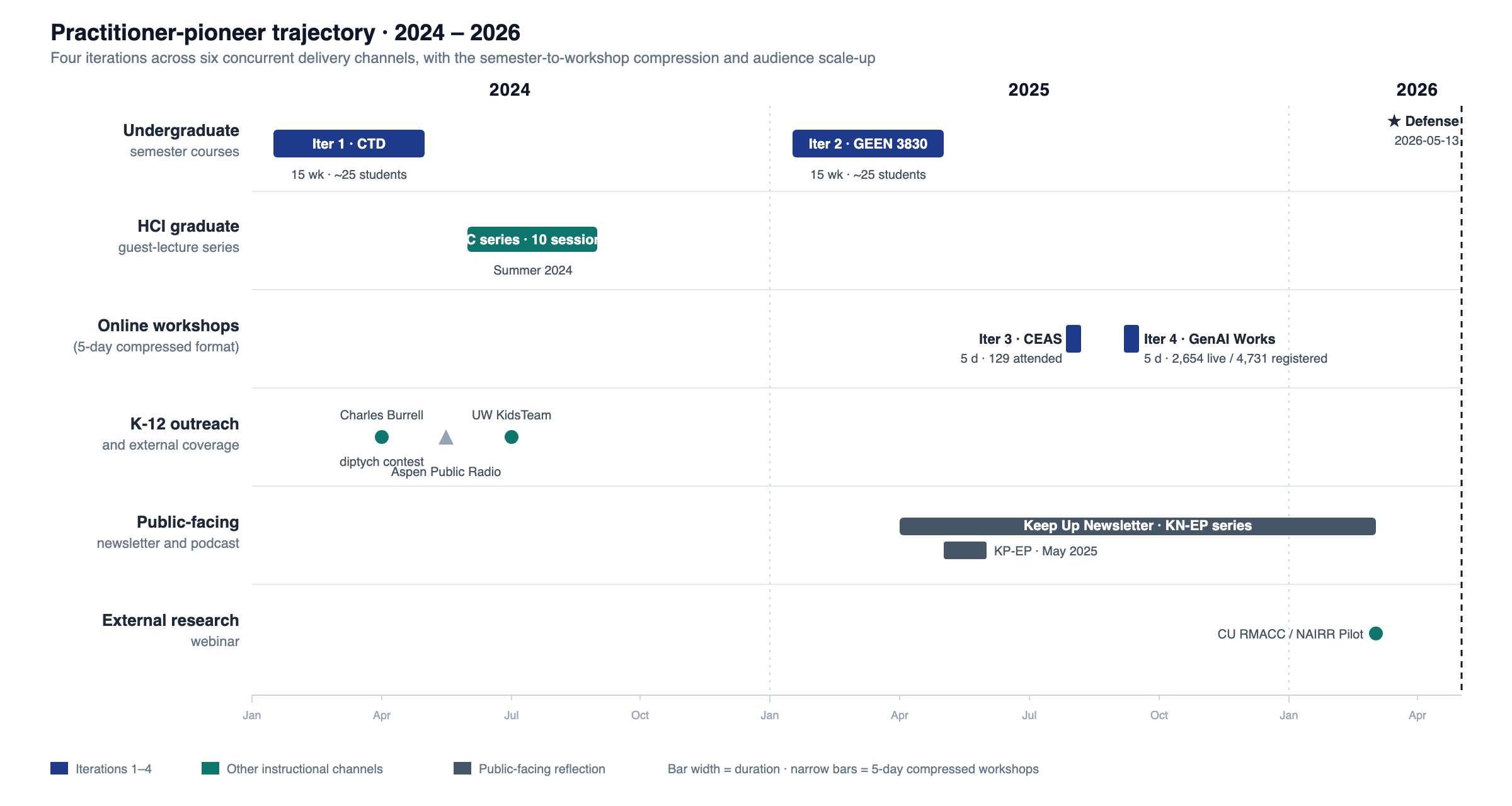
Figure C.1 below visualizes the practitioner-pioneer trajectory across six concurrent delivery channels for the entire period covered by this dissertation. The four iterations of the generative-AI course appear along the iteration spine (Iterations 1 and 2 as fifteen-week semester bars, Iterations 3 and 4 as compressed five-day workshops); the other channels (HCI graduate guest lectures, K-12 outreach, public-facing reflection through the Keep Up Newsletter and Podcast, and the CU RMACC federal-research webinar) appear in their own swimlanes. The figure orients the iteration narratives that follow.
C.1.1 What an analytic-autoethnographic narrative does with iteration data
Chapter B established the methodological framework I run on. Anderson's (2006) analytic autoethnography requires that the autoethnographer's insider position be the analytic resource, that reflexivity be analytic rather than confessional, and that the dialogue with informants beyond the self be substantive. These commitments shape how I narrate each iteration.
The narration is not a sequence of class-by-class summaries; it is a structured account of what I built, what I observed, what I learned, and what I changed. The first-person voice is consistent throughout. Where I cite my own contemporaneous reflective journal (the Weekly Updates Prelim Document for Iteration 1, WU-1.W01 through WU-1.W15) I mark it as such. Where I cite my recorded teaching delivery (TR-4.D1 through TR-4.D5 for Iteration 4) I mark it as such. Where the iteration's reflective data is thinner (Iterations 2, 3, and 4), I name the limit and draw on the cross-iteration reflective channels (KN-EP series, KP-EP series, WB-2026-03-03) as the supplementary reflective base within an acknowledged retrospective-public frame.
C.1.2 Analytic posture as a precursor to the iteration narratives
The analytic posture I take across all four iterations is this. I treat each iteration as a connected component of a single multi-year practitioner-pioneer practice rather than as a discrete experimental trial. The unit of analysis is therefore the iteration-within-a-practice, not the iteration-as-trial. This matters because the design-conjecture-then-measure-then-refine logic of design-based research (which my proposal had specified and which I drew back from, §B.2) treats iterations as trials. The analytic-autoethnography logic I adopt treats iterations as moments in a continuing practitioner-pioneer trajectory.
The trajectory has shape. The first two iterations are semester-long undergraduate courses (CV-1 in Spring 2024, CV-2 in Spring 2025) that I treat as the consolidation phase of my pioneer practice. The second two iterations are five-day online workshops (DK-3 plus LF-3 and LR-3 in August 2025, DK-4 plus TR-4 series in September 2025) that I treat as the distillation phase. The compression-as-curriculum-maturation finding developed in §D.3 follows from this trajectory shape.
C.1.3 What each iteration narrative will cover
Each of the four iteration narratives in this chapter covers the same set of points:
- Institutional context (program, course code, audience size, sponsorship)
- Curriculum architecture as taught in that iteration
- Week-by-week or day-by-day structure where the artifacts allow
- Guest speakers and topics
- Named student work and learner outputs
- Tools introduced, retained, repositioned, or dropped
- Reflective material specific to the iteration
- Cross-iteration relationships (what the iteration learned from the previous and what it set up for the next)
The narrative depth varies by iteration depending on what the corpus supports. Iteration 1 has the most contemporaneous reflective journaling (WU-1 series); Iteration 4 has the most recorded teaching delivery (TR-4 series). I narrate each iteration with the depth its artifacts allow.
C.1.4 The patterns the iterations together exhibit
The iteration narratives in §C.2 through §C.5 surface patterns that Chapter D elaborates as autoethnographic sub-claims under the three curriculum-design principles named in the main dissertation document: modularity, learner choice, and continuous feedback. I preview the patterns here so the reader of the iteration narratives can hold the Chapter D destination in view while reading.
Architectural stability across changing surface · previews Modularity (§D.2). The four-theme architecture (Education, Industry, Ethics, Accessibility) appears in every iteration and across every delivery channel I documented. The tools change, the institutional sponsors change, the audience demographics change, the delivery duration compresses six-fold, but the architecture is stable. Chapter D §D.2 elaborates this as the inside view of the modularity principle.
Compression from semester to workshop · previews Modularity §D.2.3 (compression-as-curriculum-maturation). The shift from Iterations 1 and 2 (fifteen-week semester courses) to Iterations 3 and 4 (five-day online workshops) is the most consequential structural move in the practitioner-pioneer trajectory. The cross-iteration analysis in §C.6 documents the move in detail, and Chapter D §D.2.3 develops the compression-as-curriculum-maturation sub-claim as the autoethnographic reading of that move under modularity.
Each iteration as a different choice-architecture for learners · previews Learner Choice (§D.3). Each iteration positions a different audience in a different relationship to choice over what to attend to, which tools to use, and how to demonstrate learning. Iteration 1 frames choice through a fifteen-week sequenced curriculum with a final project; Iteration 2 frames it through student teach-outs; Iteration 3 compresses choice into a five-day workshop with Luma feedback; Iteration 4 carries the same compression into a second cohort with day-by-day transcripts. Chapter D §D.3 elaborates this as the multi-channel teaching practice sub-claim under learner choice.
Continuous learner observation as the engine of revision · previews Continuous Feedback (§D.4). Across the iterations, what learners produced and said inside each iteration is what shaped the next. Weekly journal entries from Iteration 1 (WU-1 series), Iteration 3 Luma feedback (LF-3), and Iteration 4 day-by-day transcripts (TR-4 series) are the explicit records of this loop. Chapter D §D.4 elaborates this as the reflexive loop in practice and develops the hallucination-as-pedagogy sub-claim under continuous feedback.
Sections C.2 through 3.5 present the four iteration narratives in order. Section C.6 presents the cross-iteration comparative analysis.