Iteration 1 · CTD Pilot · Spring 2024
C.2.1 Institutional context
Iteration 1 was the first generative-AI course at the University of Colorado Boulder offered through the ATLAS Institute (RE-Q3). The course was hosted within the Creative Technology and Design (CTD) program, ATLAS's undergraduate program for radical creativity and innovation. The audience was approximately twenty-five CTD undergraduates. The duration was fifteen weeks: January 17, 2024 through May 1, 2024.
This was the discovery phase of my pioneer practice. I had no precedent at CU Boulder to draw on; my prior teaching of generative-AI material had been in K-12 settings (RE-Q2 through RE-Q3) and in the Charles Burrell School of Arts diptych contest. The CTD pilot was where I built the four-theme curriculum architecture (§A.4) for the university-level setting.
C.2.2 Week 1 · January 17, 2024 · Prompt engineering opener
Week 1 opened with prompt engineering. The Week 1 deck (DK-1.W01) carries thirty-five slides and twenty-three named student prompt-engineering outputs from the opening session. The named outputs are the visible trace of the dialogue-with-informants-beyond-self criterion (§B.3.4) at the very beginning of the iteration.
Two of the twenty-three named students are traceable across the cross-iteration corpus. Ashley Stafford appeared in the Week 1 deck and was subsequently quoted in the Aspen Public Radio article (AP-2024-05-16) published one week after the iteration ended. Ethan Cuenca appeared in the Week 1 deck and was publicly credited in my Keep Up Newsletter Episode 3 (KN-EP3-Q1, "I learned about Soundful from one of my students during class") as the student whose tool discovery shaped Iteration 2's curriculum. The two cross-iteration cases are documented in §C.6.4 as named instances of the student-to-instructor tool flow that pioneer practice produces.
The Week 1 Weekly Updates entry (WU-1.W01) carries my contemporaneous reflective observations. The "Learned" section captures two distinct observations:
WU-1.W01-Q1: "I learned that some of the multiple choice quizzes generated by ChatGPT were not correct and had hallucinations."
WU-1.W01-Q2: "I learned that the students enjoyed creating the alter-ego images to describe themselves to the class."
The first observation is the seed of the hallucination-as-pedagogy finding I develop in §D.2. The second observation captures what the Midjourney Self-Portrait Assignment opened up: students using image generation to introduce themselves to their classmates as a low-stakes way to surface their own voices in the early weeks. Both observations were made in the first week of the first iteration.
C.2.3 Weeks 2 to 4 · Education theme
The Education theme occupied the first major curricular block of Iteration 1. Two guest speakers carried the theme:
- Anthony Pinter (ATLAS) on creativity and emerging-technology pedagogy
- Nolan Brady and Shivendra on Education applications of generative AI
The block also brought Diane Sieber (Herbst Program for Engineering, Ethics, and Society) into the course to discuss writing with generative AI. Sieber is a member of my dissertation committee and one of the two PIs on the AI-IRT Seed Grant that funded the broader research arc (AI-PROPOSAL). Her appearance as a guest in Iteration 1 was within the Education theme, framed around the writing question that her own teaching had been engaging.
C.2.4 Weeks 5 to 9 · Industry theme
The Industry theme carried generative-AI tools and practices into workplace contexts. Two guest speakers anchored the block:
- Matt Zago on video generation and industry applications of generative-AI video tools
- Daniel Ritchie of Hugging Face for a workshop session on open-model use
Ritchie's session was structured as a workshop rather than a lecture. The Canvas export (CV-1) records the session as a hands-on Hugging Face engagement that introduced students to model selection and use beyond the closed proprietary tools (DALL-E, ChatGPT, Midjourney) that the early weeks had emphasized.
C.2.5 Weeks 10 to 12 · Ethics block
The Ethics theme occupied a distinct block in Iteration 1. Two guest speakers carried it:
- Nikolaus Klassen (Google) on industry-internal ethics of generative AI
- Suibi Weng on Reality Editor and the question of mixed-reality augmentation
The Ethics block stands somewhat apart from the cross-cutting framing I describe in §A.4. The Iteration 1 curriculum gave Ethics a dedicated block as well as cross-cutting attention. In the Iteration 2 syllabus (SY-2) I committed more fully to the cross-cutting framing and removed the dedicated block. Section C.6.2 documents the structural shift between iterations.
C.2.6 Weeks 13 to 15 · Accessibility theme and Final Project
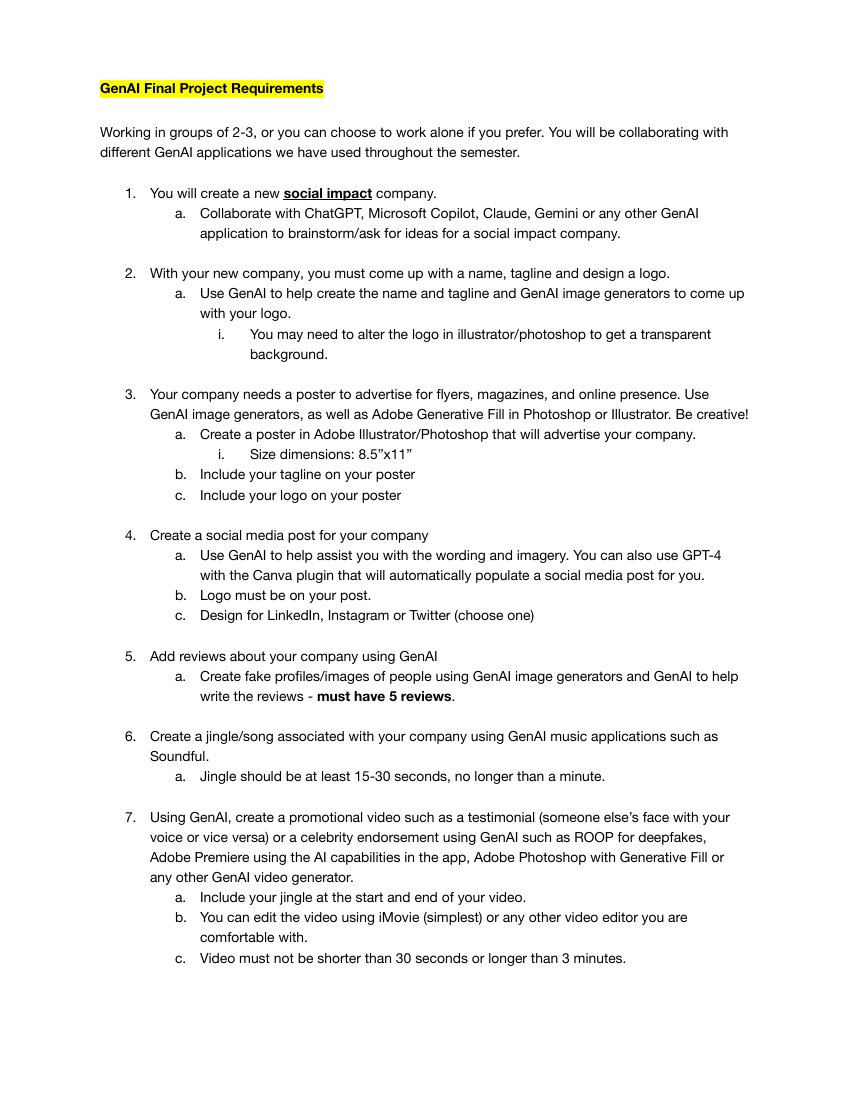
The closing block carried the Accessibility theme and the course's Final Project. The Final Project Requirements (FP-1) document a Media Studies-style company-creation assignment with nine reflection questions distributed across the four themes. The ethics question among them, "Do you think this will eliminate creative jobs?", made the cross-cutting Ethics theme present within the Accessibility-dominant final weeks.
The Final Project asked each student to design a company that used generative-AI tools and to explain the company's positioning within the four themes. The assignment produced student-level four-theme syntheses that became part of the dialogue-with-informants evidence base for §B.3.4.
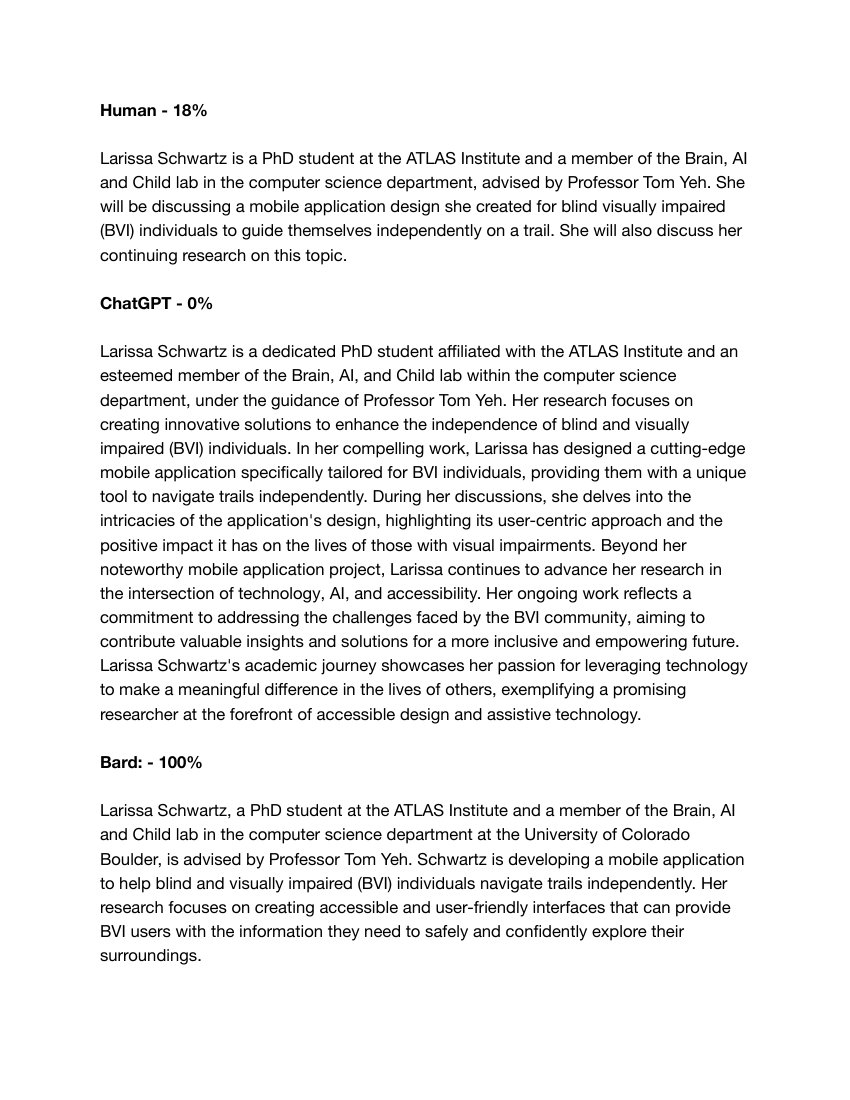
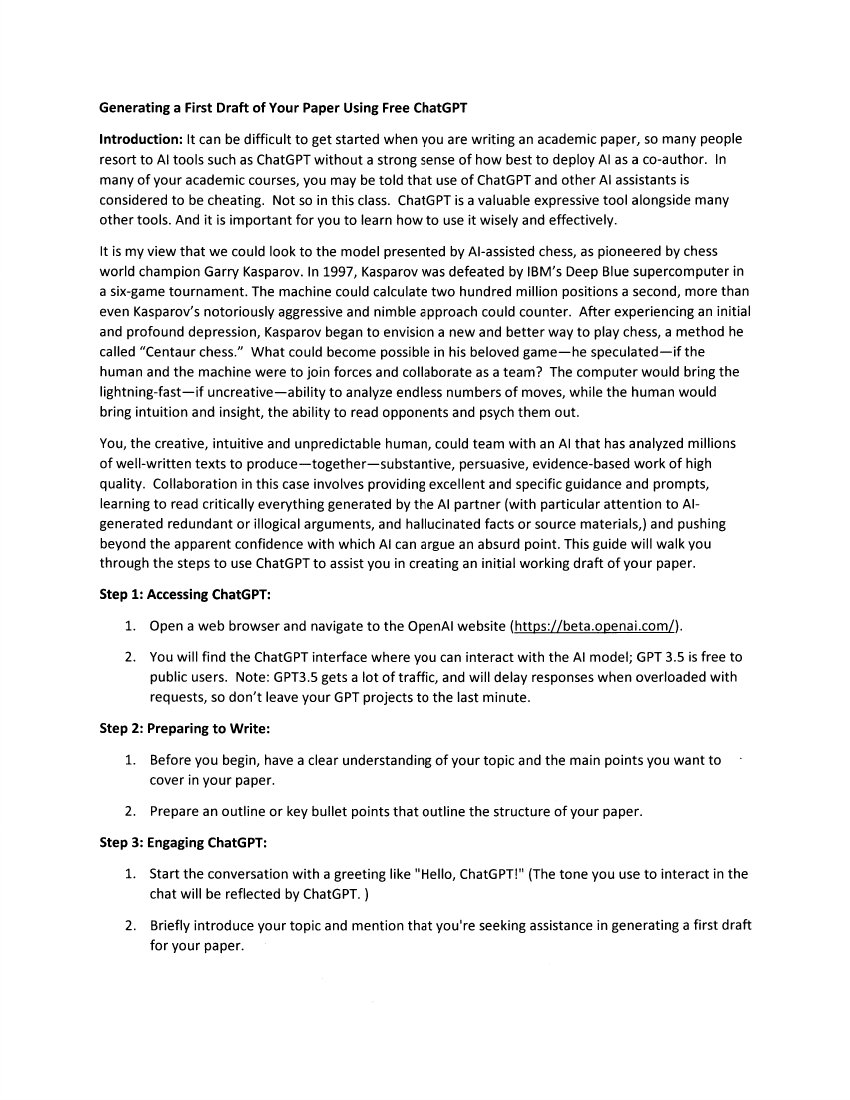
\autoref{fig:iter1-canvas-materials} samples three of the curriculum materials preserved in the Iteration 1 Canvas export (CV-1). The materials span the semester: the Week 3 writing-with-GenAI assignment I authored, the Week 4 handout that Diane Sieber prepared for her guest discussion, and the closing Final Project Requirements that operationalized the four-theme architecture as the capstone assignment.
C.2.7 Aftermath · Aspen Public Radio coverage
One week after Iteration 1 ended, on May 16, 2024, Aspen Public Radio published an article titled "Could AI be the next college teaching assistant? Some Colorado professors believe so" (AP-2024-05-16). The article named me as the instructor of the course and quoted my Iteration 1 student Ashley Stafford on what the course had offered. The article's framing aligns with the Education theme of the four-theme architecture; its publication immediately after the iteration ended provides external corroboration that the iteration had landed pedagogically. I cite the article at source-level (AP-2024-05-16) in this dissertation.
C.2.8 What I learned across Iteration 1
The Weekly Updates Prelim Document (WU-1.W01 through WU-1.W15) carries my contemporaneous "Learned" entries across all fifteen weeks. The entries are short and structured: each week records what I had taught, what guests had come, what resources I had used, what I had learned, and what students had produced. The "Learned" entries are the most analytically valuable; they capture what the teaching had taught me, week by week, before retrospection set in.
Selected verbatim "Learned" entries that mark the arc of the iteration:
Week 2 (WU-1.W02-Q1, on tool accessibility and bias):
"I learned that Midjourney is not free and can only be accessed through Discord. I learned that Midjourney images are far superior than any other GenAI image generators. I learned more about the bias associated with image generation within GenAI applications."
Week 3 (WU-1.W03-Q1, on AI content detection and institutional context):
"I learned that AI content detectors are unreliable. I learned that every professor at the university has a different rule when it comes to using GenAI in their classroom."
Week 5 (WU-1.W05-Q1, on cross-industry application):
"I also learned that various generative AI applications can benefit various industries, including surveillance, healthcare, marketing, advertising, education, gaming, media, podcasting, and more."
Week 6 (WU-1.W06-Q1, on the SORA video model and its limits):
"I learned that SORA is going to be a game changer in the video/movie industry, but there are still a lot of issues that need to be addressed before releasing this product. I learned that GenAI is not only used creatively but can be used within all types of different industries, such as finance."
Week 7 (WU-1.W07-Q1, on deepfakes and student concern about creative originality):
"I learned about Deepfakes and the ethical concerns surrounding them, as well as how to create them. I learned Deepfakes have been around for a while, as they used to be called Shallowfakes (using photoshop to alter images). I learned about the ethics surrounding music generation with GenAI. I learned that students are concerned with the originality of their music/art when using these different GenAI applications."
Week 14/15 (WU-1.W14-Q1, on accessibility and final-project execution):
"I learned about different assistive technologies and applications that Derek uses daily, and which ones he recommends. I also learned about how he uses them for specific tasks. I learned how fast it took students to create marketing for a company from scratch, using different GenAI applications. I learned about new GenAI applications and the specific ones that the students preferred to use for their project."
Three patterns visible in the fifteen-week record are worth marking here.
First, hallucination as teachable phenomenon surfaced in the first week (WU-1.W01-Q1) and recurred throughout the semester as a teaching topic rather than as a problem to be hidden. The hallucination-as-pedagogy finding (§D.2) is anchored at this iteration's first week.
Second, the four-theme architecture stabilized through the iteration. The ForeverGold deck (DK-1.FG, slides 5-9) names the four themes as the course framing from the beginning; the iteration's week-by-week structure tested the framing against the curriculum as actually delivered. The architecture survived the iteration intact. The "Learned" entries above visibly trace the four themes: Week 3 covers Education (institutional policy on GenAI), Weeks 5 and 6 cover Industry (cross-industry application, SORA in the video industry), Week 7 covers Ethics (deepfakes and music ethics, student concern about originality), Weeks 14 and 15 cover Accessibility (Derek Riemer's lived experience with assistive technologies).
Third, the iteration produced student work that subsequently shaped Iteration 2. The Ethan Cuenca-to-Soundful flow (KN-EP3-Q1) is one named case; the iteration also produced student-to-tool discoveries that I carried into the Iteration 2 syllabus (SY-2) without always crediting the student source in the curriculum itself. The flow is documented in §C.6.4 as the student-to-instructor tool flow pattern.
These three patterns establish Iteration 1 as the discovery phase of my pioneer practice. Iteration 2, narrated in §C.3, was the consolidation.